Showing posts with label buildings. Show all posts

Sunday, November 21, 2010

Valentino Castle (Castello del Valentino), Turin, Italy

Public Domain Photo: Castle of Valentino (Castello del Valentino), in the Valentino Park, Turin, Italy

The Castle of Valentino (Castello del Valentino), a UNESCO World Heritage Site in Valentino Park in the north-west Italian city of Turin, is the seat of the Architecture Faculty of the Polytechnic University of Turin.

The Valentino Castle is believed to derive its name from Saint Valentine whose relics were venerated in a church nearby. The castle has a horseshoe shape with four round towers at each angle, and a wide inner court with a marble pavement.

Saturday, November 13, 2010

Piazza Carlo Alberto (Carl Albert Square), Turin, Italy

Public Domain Photo: Piazza Carlo Alberto (Carl Albert Square) is in Turin (Torino), a major city which is a business and cultural centre in northern Italy, located mainly on the left bank of the Po River surrounded by the Alpine arch. Before 1842 Piazza Carlo Alberto was the garden of the Palazzo Carignano, and in 1842 a park was opened here for the general public. The monument dedicated to Carlo Alberto stands at the center of the square. Piazza Carlo Alberto also houses the famous National University Library.

Dimension and size: 2592×1944 pixels – 1230 KB

Download the ORIGINAL PHOTO

Tuesday, November 9, 2010

Traditional Arts and Customs Museum in Seville, Spain

Public Domain Photo: The Traditional Arts and Customs Museum (Museo de Artes y Costumbres Populares) on Plaza de América, Parque de María Luisa, in Seville, Spain.

Museo de Artes y Costumbres Populares (The Museum of Arts and Traditions in Seville, Andalusia, Spain) is located in the María Luisa Park, across the Plaza de América from the Provincial Archeological Museum.

The museum occupies the Mudéjar Pavilion (Pabellón Mudéjar) built in 1914, and several alterations and additions have been carried out since then. The museum was established by a decree of 23 March 1972, initially as a section of the Museum of Fine Arts of Seville. The permanent exhibition space amounts to 5,496 square meters (18,031 feet).

Monday, November 8, 2010

Torre del Oro (The Gold Tower), Spain


Public Domain Photos: Torre del Oro (The Gold Tower), Spain

Torre del Oro (The Gold Tower), a dodecagonal watchtower in Seville, southern Spain, was built in the 13th century by the Berbers during the rule of Almohad dynasty to control access to Seville via the Guadalquivir River. The tower has three levels, and the third and uppermost level is circular and constructed in 1760.

The Torre del Oro served as a prison during the Middle Ages and as a secure storage tower for precious goods such as gold, silver, gems, pearls, spices, sugar, tobacco, silk, and other exotic goods brought from Spanish colonies to Spain by the Spanish treasure fleets (West Indies Fleet from Spanish Flota de Indias).

Currently the tower is a naval museum for engravings, letters, instruments and historic documents, and the museum outlines the naval history of Seville and the importance of Guadalquivir River.

Sunday, October 31, 2010

The Taj Lake Palace


PD Photos: The Taj Lake Palace, a luxury hotel located on Jag Niwas Island in the middle of Lake Pichola in Udaipur.

The Taj Lake Palace, formerly known as Jag Niwas Palace, is an unusual, unique luxury hotel of 83 rooms and suites, located on the Jag Niwas Island in the middle of Lake Pichola in Udaipur, India. It looks like a floating, huge palace in the middle of the lake.

The palace was built in the period 1743-46 by Maharana Jagat Singh II, the 62nd successor to the royal dynasty of Mewar, for use as his royal summer palace. The successive rulers also used the Lake Palace as their summer resort, holding their regal Durbars in its courtyards lined with columns, pillared terraces, fountains and gardens.

The palace is set against the backdrop of the majestic Aravalli Mountains on one side of the lake and lofty palaces on the other side. Built in marble, the walls are ornamented with arabesques of different colored stones as in the Taj Mahal at Agra.

During the reign of Bhopal Singh (1930-55) another pavilion, Chandra Prakash, was added. His successor Bhagwat Singh decided to convert the palace into Udaipur’s first luxury hotel.

In 1971, Taj Hotels Resorts and Palaces (collective name for The Indian Hotels Company Limited and its subsidiaries owned by the Tata Group) took over management of the hotel. The Royal Butlers, the descendants of the original palace butlers, look after the comforts of the hotel guests.

The Lake Palace was featured in the 1983 James Bond film Octopussy, as the floating palace of the fabulously wealthy woman Octopussy, played by Bond girl Maud Adams.

Friday, October 22, 2010

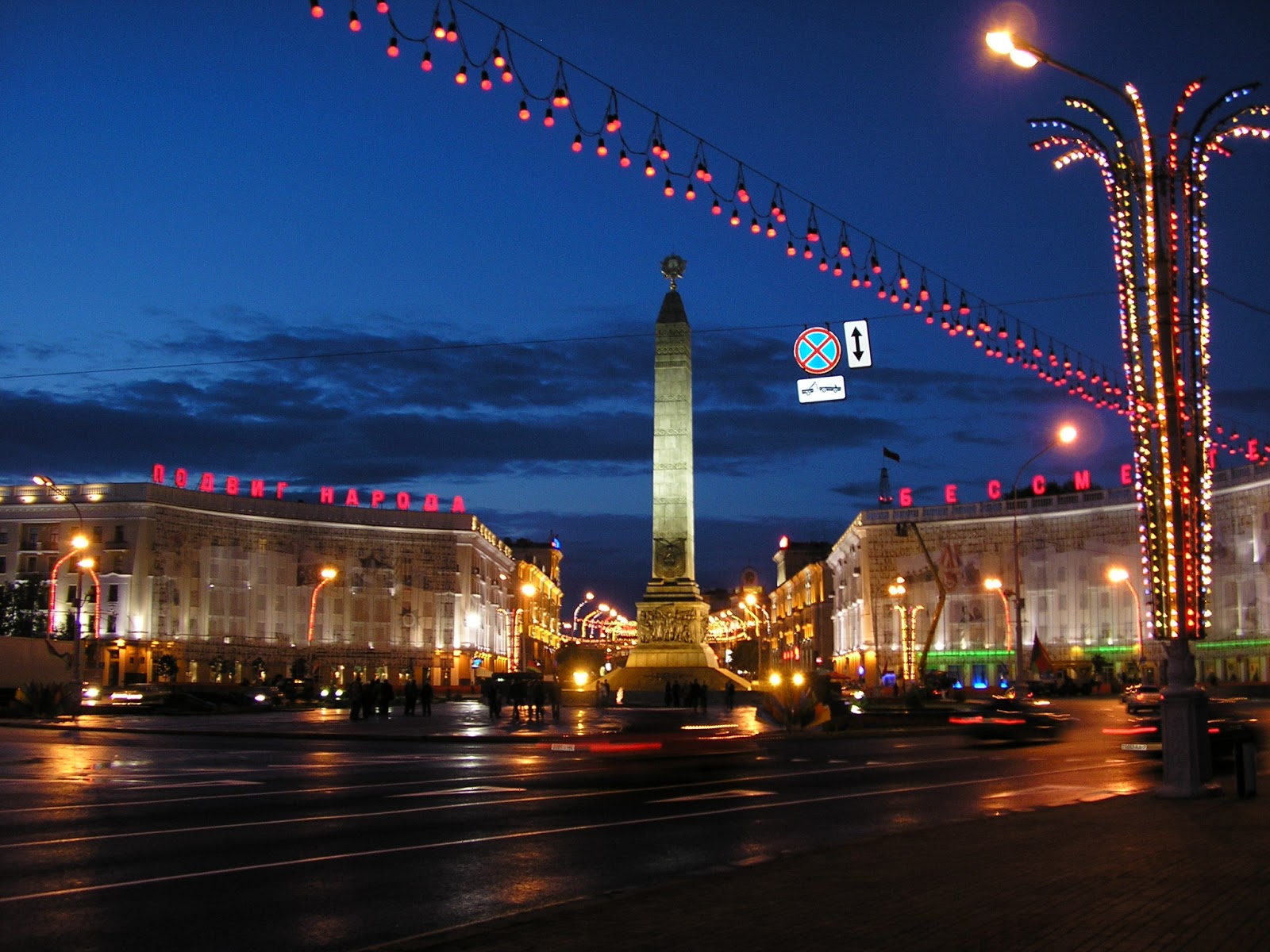
Victory Square and Victory Monument in Minsk, Belarus

PD Photo: Victory Square and the Victory Monument in Minsk, built in 1954 in honour of the soldiers of the Soviet Army and partisans of Belarus. A 3-meter replica of the Order of Victory crowns a 38-meter tall granite column. The Sacred Sword of Victory is at the base of the monument. The text over the buildings reads ‘Подвиг народа – бессмертен’ (The Feat of the People is Immortal).

Victory Square, the key landmark of Minsk, is located in the historic center of the city with the museum of the 1st Congress of RSDRP, Main offices of National State TV and Radio, and the City House of Marriages, where newly married couples traditionally take their photos.

Wednesday, October 20, 2010

The CN Tower, Toronto

PD Photo: The CN Tower, the world's fourth tallest manmade structure, Toronto's most visible landmark and its most celebrated tourist destination

PD Photo: The CN Tower as seen from its base

The CN Tower, constructed in 1973-1976 for use as observation tower, telecommunications tower and a major tourist attraction, is in Downtown Toronto, Canada. The CN Tower, standing 553.33 meters (1,815.4 feet) tall, is now the fourth tallest in the list of tallest buildings and structures in the world. It attracts over two million international visitors annually.

In 1995, the CN Tower was declared one of the modern Seven Wonders of the World by the American Society of Civil Engineers. The architects of the CN Tower are John Andrews Architects and WZMH Architects (formerly known as the Webb Zerafa Menkes Housden Partnership).

Buildings and structures in the world, taller than the CN Tower are:

1. Skyscraper (all categories): Burj Khalifa, United Arab Emirates, Dubai, 828 meters (2,717 feet) tall, officially opened on 4 January 2010.

2. Guyed Mast: The KVLY-TV mast (formerly the KTHI-TV mast), Blanchard, Traill County, North Dakota, United States, 628.8 meters ( 2,063 feet) tall, completed in 1963.

3. Concrete Tower (Topped out): Canton Tower (also known as Guangzhou TV & Sightseeing Tower), near Chigang Pagoda, Haizhu District, Guangzhou, Guangdong, China, 610 meters (2,001 feet) tall, topped-out in 2009 and became operational on September 29, 2010.

4. Concrete Tower: CN Tower, Toronto, Canada, 553.3 meters/ 1,815 feet tall, opened to the public on June 26, 1976.

Tuesday, September 7, 2010

The western front of the United States Capitol

PD Photo: The western front of the United States Capitol, the Neoclassical style building, located in Washington, D.C., on top of Capitol Hill at the east end of the National Mall. Source File: 3,000 x 1,556 pixels, file size: 5.18 MB, image/jpeg, AOC, US Govt. (CLICK to download the original photo) Author: The Architect of the Capitol (AOC), the federal agency responsible for the maintenance, operation, development, and preservation of the United States Capitol Complex; the Architect of the Capitol is in the legislative branch and is responsible to the United States Congress.

Saturday, June 19, 2010

Botanical Garden, Berlin

The Botanical Garden in Berlin (Botanischer Garten und Botanisches Museum Berlin-Dahlem) with an area of 43 hectares, home to around 22,000 different species of exotic plants brought in from erstwhile German colonies is one of the most important gardens in the world. Located in Dahlem neighborhood of the borough of Steglitz-Zehlendorf, it was constructed between 1897 and 1910 under the supervision of architect Adolf Engler.

Now, being a part of the Free University of Berlin, the Botanical Museum complex, with a large herbarium and a large scientific library, consists of several buildings and glasshouses, such as the Cactus Pavilion and the Pavilion Victoria, and its arboretum is spread over 14 hectares. The Great Pavilion, the largest glasshouse in the world, is a 25-meter tall steel structure covered by glass with floor area of width 30 meters and length 60 meters, with a constant temperature level at 30 °C and high air humidity.

Thursday, June 3, 2010

Waterfront houses in Istanbul

Photo: The traditional waterfront houses (2007) in the Yeniköy neighborhood lining up the shores on the European side of the Bosphorus in Istanbul.

The Bosphorus (Bosporus or the Istanbul Strait) is a strait that forms part of the boundary between Europe and Asia. It is one of the Turkish Straits along with the Dardanelles. The world's narrowest strait used for international navigation and about 30 km long, it connects the Black Sea with the Sea of Marmara, which is connected by the Dardanelles to the Aegean Sea, and thereby to the Mediterranean Sea. The shores of the Bosphorus are thickly populated, with Istanbul alone, with a metropolitan area in excess of 11 million inhabitants, straddles it.

Tuesday, March 23, 2010

Grauman's Chinese Theatre at Hollywood Boulevard

Grauman's Chinese Theatre, a movie theater located at 6925 Hollywood Boulevard in Hollywood along the historic Hollywood Walk of Fame, was commissioned following the success of the nearby Grauman's Egyptian Theatre opened in 1922. Built over 18 months by a partnership led by Sid Grauman, the theater was inaugurated on May 18, 1927 with the premiere of Cecil B. DeMille's film The King of Kings. Since then Grauman's Chinese Theatre has been home to many premieres, birthday parties, corporate junkets and three Academy Awards ceremonies. Concrete blocks in the forecourt that bear the signatures, footprints, and handprints of popular motion picture personalities from the 1920s to the present day are one of the theater's most distinctive features.

Thursday, March 11, 2010

Kodak Theatre at Hollywood Boulevard

The Kodak Theatre, a live theatre in the Hollywood and Highland retail, dining, and entertainment complex on Hollywood Boulevard and North Highland Avenue in Los Angeles, was opened on November 9, 2001 with a seating capacity for 3,400 people. The theatre has been the home of the annual Academy Awards (Oscars) since March 2002 and the first permanent home for the Oscars. The stage is one of the largest in the United States, measuring 113 feet (34 m) wide by 60 feet (18 m) deep. The theatre was sponsored by the Eastman Kodak company that paid $75 million to have its name associated with the building owned by the CIM Group.

Monday, March 8, 2010

The Dolmabahce Palace, Turkey

The Dolmabahçe Palace, or Dolmabahçe Sarayı in Turkish, in Istanbul, Turkey, located at the European side of the Bosporus, used to be the main administrative center of the Ottoman Empire from 1856 to 1922, except a twenty-year interval from 1889 to 1909 in which the Yıldız Palace was used. The Dolmabahce Palace was built between 1843 and 1856 under the orders of the Turkish Empire's 31st Sultan, Abdülmecid I. The 45,000 square meter mono-block palace stands on an area of 110,000 squire meters. Hacı Said Ağa was responsible for the construction work of the palace, while the project was conceptualized by architects Garabet Balyan, his son Nigoğayos Balyan and Evanis Kalfa.