Showing posts with label Bouguereau. Show all posts

Sunday, January 30, 2011

Bouguereau: The First Mourning - 1888

Public Domain Photo: The First Mourning (Premier Deuil), an oil on canvas painting of dimensions 203 cm x 252 cm (appx 80 x 99 inches) by French painter William Bouguereau, National Museum of Fine Arts in Buenos Aires.

The oil painting ‘The First Mourning’ (1888) is acclaimed to be one of the best paintings by the traditionalist French artist William-Adolphe Bouguereau (1825-1905), whose realist genre of creations and a host of other paintings depicting mythological and Biblical characters and scenes became very popular with the aristocracy and the rich art patrons of his times.

His interpretations of classical themes in a photo-realistic style were heavily influenced by the beauty of feminine human body. In later years, Bouguereau seemed to have been given much less appreciation compared to the Impressionists.

The theme of the painting features the moment when Adam and Eve found their son Abel, who was murdered by his elder brother Cain, whom some writers interpret literally as the son of the serpent (evil) in the Garden of Eden.

According to the Bible, it was the first death of a human being, and hence it is considered the first murder and ‘The First Mourning’ (the work is titled ‘Premier Deuil’ in French). Abel is also considered the first innocent victim and the first martyr while Cain is considered the first murderer by many writers.

The First Mourning is currently displayed at the Museo Nacional de Bellas Artes (National Museum of Fine Arts) in Buenos Aires, Argentina.

Saturday, August 14, 2010

Gabrielle Cot by William-Adolphe Bouguereau

PD Image: Portrait de Gabrielle Cot, alternative name, Portrait of Gabrielle Cot, 1890 oil painting by William-Adolphe Bouguereau

Friday, August 13, 2010

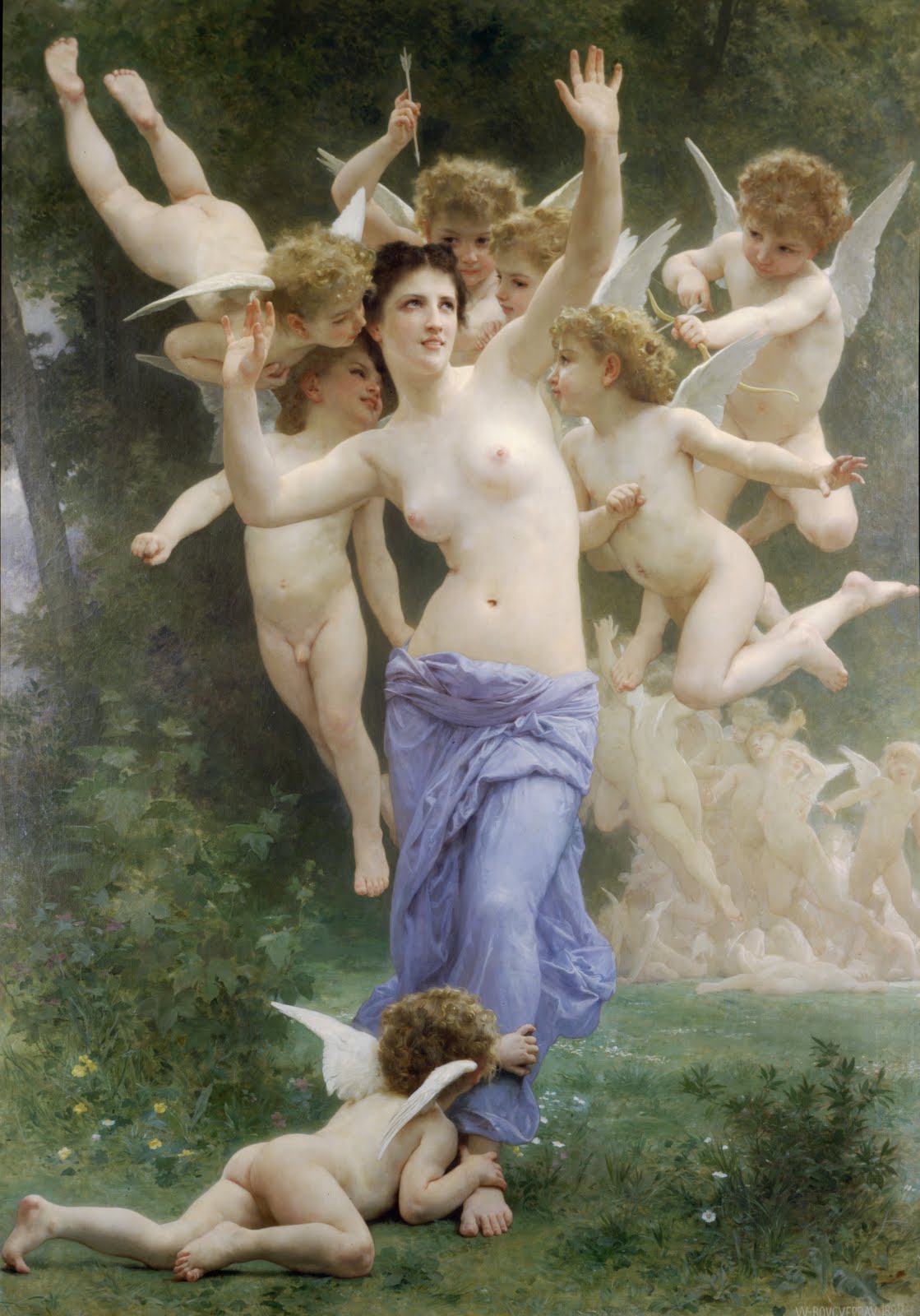
The Invasion by William-Adolphe Bouguereau

PD Image: The Invasion (1892), with alternative titles ‘Le Guêpier’ literally translated as ‘The Bee’, also known as ‘The Wasp's Nest’, created by the French academic painter William-Adolphe Bouguereau (1825-1905), oil on canvas painting, size 83.75 x 60 inches (213 cm x 152.5 cm), private collection.

The painting is signed and dated at bottom-right corner. Bouguereau used to sign his works simply as William Bouguereau, or as "W Bouguereau date" and later as "W BOVGVEREAV 1892", which can be read on the painting above (CLICK on the photo and enlarge it).

Bouguereau’s style was almost as realistic as art could get, almost photo-realistic, and it is felt by art critics that he lost out to impressionists. Though he was one of the most famous artists in his lifetime, later he almost fell to obscurity. His present day supporters include the businessman and art collector Fred Ross (New Jersey), whose Art Renewal Center heavily features Bouguereau's works. It has been reported that currently over a hundred museums throughout the world exhibit Bouguereau's works.

The Fred Ross sponsored Art Renewal Center, www.artrenewal.org, features about 63,000 images in its web site, mostly by academic and classical painters, out of which Bouguereau holds a special place of pride with 226 of his paintings posted there, according to reports.

Saturday, August 7, 2010

The works of William Adolphe Bouguereau


This video clip from YouTube shows the major works of William Adolphe Bouguereau.

The French academic painter William-Adolphe Bouguereau (1825-1905), known as William Bouguereau, as he used to sign, or simply as Bouguereau, was a traditionalist known for his realistic genre of paintings. He painted mostly mythological themes with a special emphasis on the female human body.

His almost photo-realistic style was popular with rich art patrons of his time but his technique and style seems to have lost out to the popularity of the Impressionists. Bouguereau's graceful portraits of women were very charming, partly because he could alter and beautify an artist’s model while retaining her likeness.

Bouguereau was a traditionalist whose realistic genre and mythological themes were modern interpretations of classical subjects, mythological, pagan and Christian themes. He brought to life goddesses, nymphs, bathers, shepherdesses, and Madonna’s in a way that appealed to the wealthy art patrons of his era. Bouguereau’s works were eagerly bought by American millionaires who rated him the most important French artist of his times. He was also a sought after portrait painter and many of his paintings of wealthy patrons remain in private hands. He was quite prolific and art connoisseurs identify 826 paintings to his credit.

William Bouguereau’s major works include: Alone in the World (1867), Chapel of the Virgin, Saint-Vincent-de-Paul church, Paris (1885-89), Cupidon (1875), Evening Mood (1882), La Danse (1850), L'Amour et Psyché, enfants (1890), Le Printemps (The Return of Spring) (1886), Nymphs and Satyr (1873), Premier Deuil (The First Mourning) (1888), The Birth of Venus (1879), The Bohemian (1890), The Knitting Girl (1869), The Nut Gatherers (1882), The Shepherdess (1889), and The Young Shepherdess (1885).

On 19 August 1905, Bouguereau died of heart disease in La Rochelle at the age of 79.

Friday, July 30, 2010

Orestes Pursued by the Furies by William-Adolphe Bouguereau

Image: The Remorse of Orestes or Orestes Pursued by the Furies (alternate titles in other languages - French: Les Remords d’Oreste, Portuguese: O Remorso de Orestes, and Spanish: El Remordimiento de Orestes), a 1862 oil on canvas painting by William-Adolphe Bouguereau (1825-1905), dimensions 227 cm x 278 cm, located in Chrysler Collection, Norfolk, Virginia.

According to Greek mythology, Orestes was the son of Agamemnon and Clytemnestra. Orestes was absent from Mycenae when his father Agamemnon returned from the Trojan War with the Trojan princess Cassandra as his concubine. But Agamemnon and was murdered by his wife Clytemnestra, in retribution for his sacrifice of their daughter Iphigeneia to obtain favorable winds for the Greek’s voyage to Troy. Eight years later Orestes returned from Athens and with his sister Electra avenged his father's death by killing his mother Clytemnestra and her lover Aegisthus.

According to Pindar, the young Orestes was saved by his nurse Arsinoe or his sister Electra, when Clytemnestra planned to kill him. He escaped to Phanote on Mount Parnassus, where King Strophius sheltered and raised him. When he was twenty years old, his sister Electra urged him to avenge his father's death. So he returned home along with his friend Pylades, son of King Strophius.

In ‘The Greek Myths’ the poet Robert Graves translates and interprets the legends and myths about Clytemnestra, Agamemnon and Orestes. Graves asserts that the sacrilege, for which the Erinyes (or Furies or Dirae in Roman mythology who were female chthonic deities of vengeance or supernatural personifications of the anger of the dead) pursued Orestes, was actually the killing of his mother, who symbolized matriarchy.

In Aeschylus's Eumenides, Orestes went mad after killing his mother and he was pursued by the Erinyes. He took refuge in the temple of Delphi. But, even though Apollo had ordered him to kill his mother, he was powerless to save Orestes. At last Athena received him on the acropolis of Athens and arranged for a formal trial of the case before a jury of twelve judges, including her. While the Erinyes demanded their victim, Orestes pleaded the orders of Apollo. When the votes of the judges were counted the result was a tie, and then Athena cast the last vote for the acquittal of Orestes.

The same myth is told differently by Sophocles and Euripides in their plays on Electra. Many other authors also wrote on the story with more details, and even contradictions.

Thursday, June 17, 2010

Femme au Coquillage: William-Adolphe Bouguereau

Image: ‘Woman with Seashell’ (Femme au Coquillage) is an 1885 oil painting by French academic painter William-Adolphe Bouguereau (1825-1905).

Wednesday, June 2, 2010

The Wave: painting by William-Adolphe Bouguereau

Photo: The Wave (1896), oil on canvas painting of dimensions 121 cm x 160.5 cm by William-Adolphe Bouguereau currently in private collection.

After the Bath - Après le bain

Photo: After the Bath - Après le bain (1894) of oil on canvas painting by William-Adolphe Bouguereau

Le Printemps (The Return of Spring)

Photo of oil on canvas painting titled Le Printemps (The Return of Spring) created in 1886 by French artist William-Adolphe Bouguereau, of dimensions 79.25 in x 46.375 in (201.30 cm x 117.79 cm) is currently on display at the Joslyn Art Museum in Omaha, Nebraska, United States. It is one of the best known works of Bouguereau.

Les Deux Baigneuses by Bouguereau

Painting: Les Deux Baigneuses (1884) by French painter William-Adolphe Bouguereau (1825-1905), oil on canvas painting.

L'Etoile Perdue by William Bouguereau

Painting: L'Etoile Perdue (Lost Pleiad) by French painter William-Adolphe Bouguereau, oil on canvas painting of 1884, dimensions 195.5 x 95 cm located in private collection.

Nu assis by William-Adolphe Bouguereau

Painting: Nu assis (1884) by William-Adolphe Bouguereau, oil on canvas painting.

Biblis by William-Adolphe Bouguereau

Painting: Biblis (1884) by William-Adolphe Bouguereau, oil on canvas painting.

La Nuit by William-Adolphe Bouguereau

Painting: La Nuit (1883) by William-Adolphe Bouguereau, oil on canvas painting.

Evening Mood by William-Adolphe Bouguereau

Painting: Evening Mood (1882) by William-Adolphe Bouguereau, oil on canvas, dimensions 207.5 x 108 cm (81.69 x 42.52 in), currently located at National Museum of Art, Havana, Cuba.

Dawn by William-Adolphe Bouguereau

Painting: Dawn (1881) oil-on-canvas painting by William-Adolphe Bouguereau.

After the Bath by William-Adolphe Bouguereau

Painting: After the Bath (1875) oil-on-canvas painting by William-Adolphe Bouguereau

The Bather (1970) by William Bouguereau

Painting: The Bather (1970) oil-on-canvas painting by William-Adolphe Bouguereau

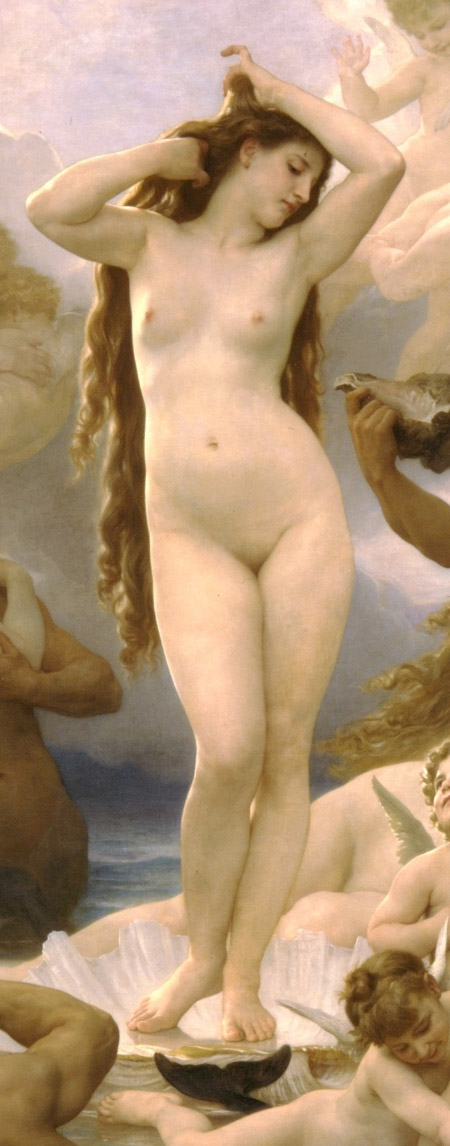
The Birth of Venus by William-Adolphe Bouguereau

Painting: oil on canvas, dimensions 300 cm x 218 cm (120 in x 86 in) currently located at Musée d'Orsay, Paris.

The Birth of Venus or La Naissance de Vénus (1879) is one of the most famous paintings by the 19th century French painter William-Adolphe Bouguereau, depicting not the actual birth of Venus from the sea, but the transportation of Venus in a shell (a visual metaphor for the vulva) from the sea to Paphos in Cyprus.

Detail from The Birth of Venus by William-Adolphe Bouguereau

Painting: Detail from oil painting ‘The Birth of Venus’ (1879) by French painter William-Adolphe Bouguereau