Showing posts with label mythology. Show all posts

Friday, June 3, 2011

Jean-Balthazar Keller: Adonis, bronze sculpture

Public Domain Photo: Adonis,a bronze sculpture inspired by an antique sculpture from the French royal collections, created by the Swiss sculptor and gunfounder Jean-Balthazar Keller (1638-1702), cast in 1687, dimensions H: 1.62 m (5 ft. 3 ¾ in.), W: 70 cm (27 ½ in.), located at Louvre Museum, Paris.

Tuesday, December 7, 2010

Rembrandt: The abduction of Europa

Public Domain Image: The abduction of Europa, known by alternate title: De roof van Europa (Ovidius, Metamorphosen II, 833-875), oil on oak panel painting (1632) by the Dutch painter and etcher Rembrandt van Rijn (1606-1669), dimensions 62.2 cm x 77 cm (24.49 in x 30.31 in) located at The J. Paul Getty Museum (Los Angeles), one of the most visited museums in the United States.

Saturday, December 4, 2010

Bronzino: Venus, Cupid, Folly and Time

Public Domain Photo: Allegorie des Triumphes der Venus (Venus, Cupid, Folly and Time), oil on wood painting(created around1545) by Angelo Bronzino (1503-1572), dimensions 146 cm x 116 cm (57 in x 46 in), located at the National Gallery, London.

Venus, Cupid, Folly and Time (also known by other titles such as ‘An Allegory of Venus and Cupid’, ‘A Triumph of Venus’, ‘Allégorie du triomphe de Vénus’, and ‘Allegoria del trionfo di Venere’), is a painting by the Florentine Mannerist artist Angelo Bronzino (1503-1572), also known as Agnolo Bronzino, Agnolo di Cosimo and Il Bronzino.

There has been extensive scholarly debate on the identity of the figures in the painting, as well as its theme, which may be described as lust, deceit, and jealousy. The figure of Venus, holding the shiny golden apple she won in the Judgement of Paris, is easily identifiable. Venus is being embraced by her son Cupid, sporting his characteristic wings and quiver. The baldheaded, bearded figure is believed to be Father Time.

The identities of the other figures are to be hypothesized. The figure opposite Time, holding the drapery, is variously referred to as Oblivion, and sometimes interpreted as Night and opposing Time. The mask-like face of this figure is symbolic of the image of two actual masks lying at the lower right-hand corner.

The figure rending the hair has been often called Jealousy, an old woman, though the protruding muscles in the figure’s hands suggest it is a man. The young boy with roses and seemingly throwing them at Venus and Cupid is interpreted as Pleasure or Joy. The figure behind him is the most complex, with a face peeping out of Pleasure’s side, giving the impression of an innocent little girl, and interpreted as, ‘perhaps the boy’s companion’. But the strange thing with this girl is that she has her lower body made up of a scaly, snake-like creature and a long tail, suggesting that it can be a personification of Evil or Deception. While she holds a honeycomb or wasp’s nest in one hand and in the other hand there is a menacing creature, possibly a scorpion (with its tail or sting on the upper side), while the lower side looks like a small reptilian animal/ snake. The girl’s palms are also fitted switching positions, her right palm attached to her left arm and her left palm attached to her right arm. Some art critics describe her as "the most sophisticated symbol of perverted duplicity ever devised by an artist..."

Dimension; 3349×4226 pixels, size: 4527 KB.

DOWNLOAD THE ORIGINAL SIZE

Monday, November 29, 2010

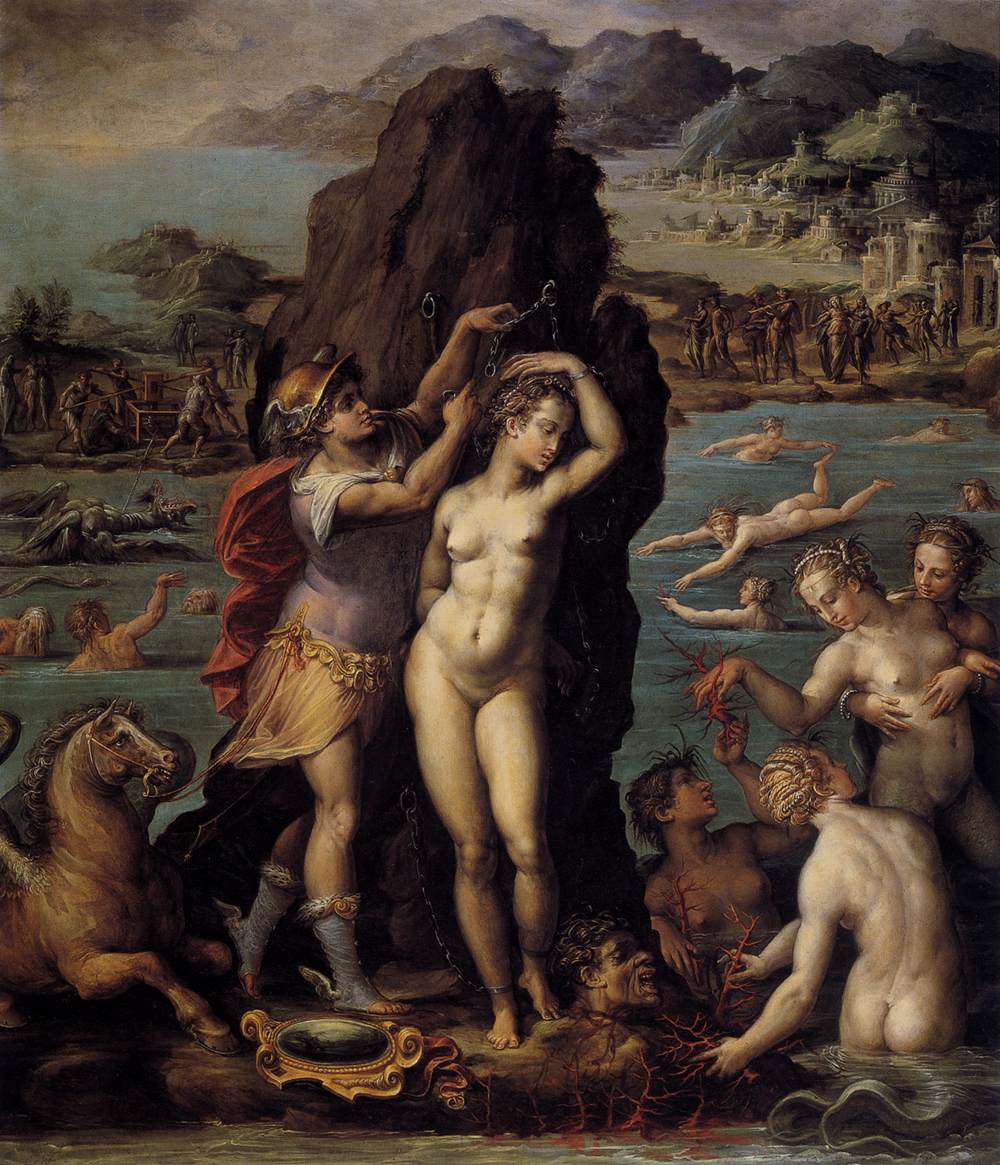
Giorgio Vasari: Perseus and Andromeda

Public Domain Image: Perseus and Andromeda, oil on slate painting by Italian painter, writer, historian, biographer of Italian artists and architect Giorgio Vasari (1511-1574), dimensions 117 cm x 100 cm, located at The Palazzo Vecchio, the town hall of Florence, Italy.

DOWNLOAD the original image (1000×1165 pixels, 169 KB)

Friday, November 26, 2010

Godward: Venus Binding Her Hair

Public Domain Image: Venus Binding Her Hair (Vénus nouant ses cheveux), oil on canvas painting (1897) by the British painter John William Godward (1861-1922), dimensions 113.6 cm x 228.3 cm (3' 8.72" x 7' 5.88"), located in private collection.

Download High Resolution Image

Tuesday, November 23, 2010

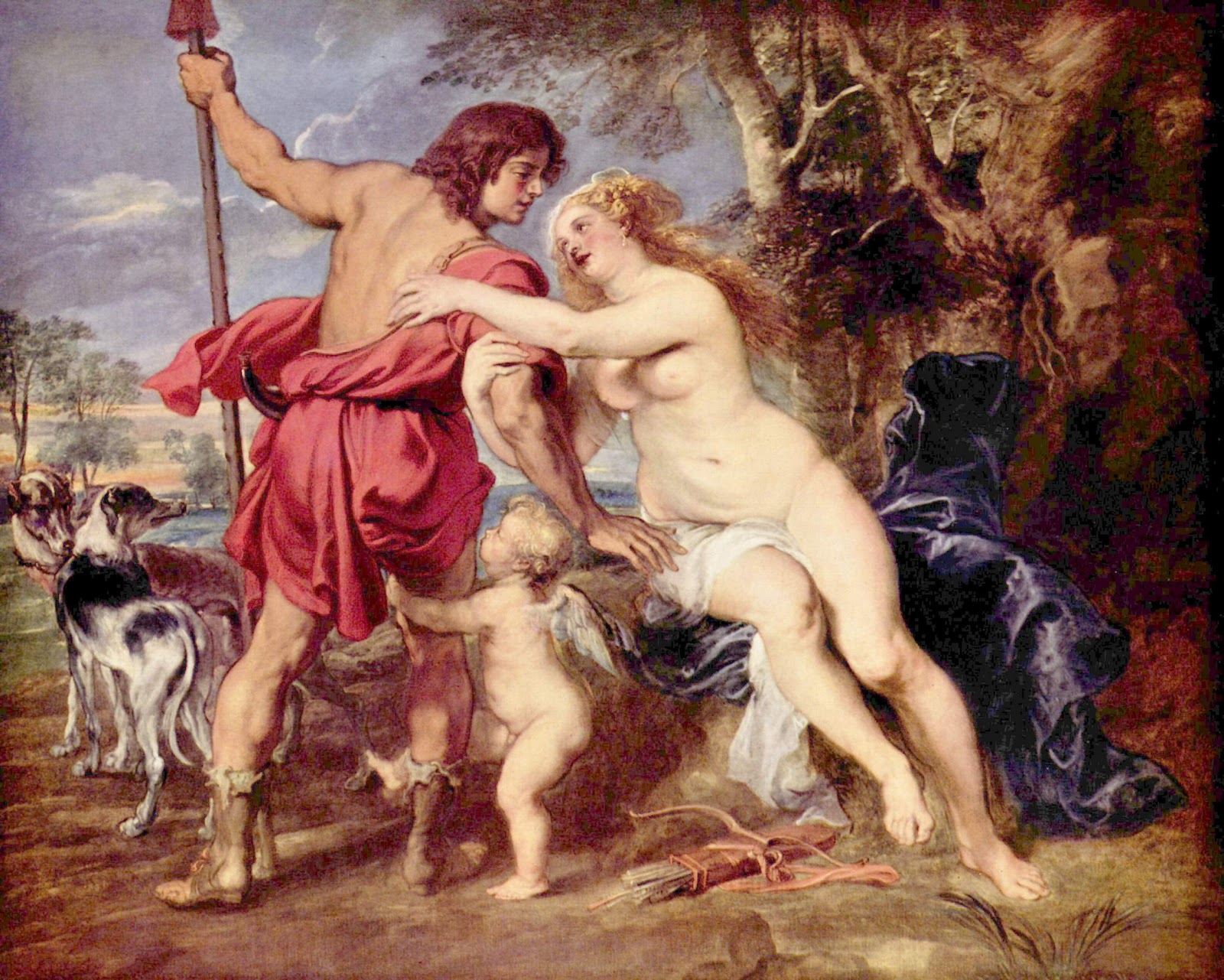
Peter Paul Rubens: Venus and Adonis

Public Domain Image: Venus and Adonis, oil on canvas painting by Flemish Baroque painter Sir Peter Paul Rubens (1577-1640), dimensions 194 cm x 236 cm, located at the Metropolitan Museum of Art, New York. Image dimensions: 2536×2030 pixels, size: 582 KB

Wednesday, November 17, 2010

Peter Paul Rubens: The Three Graces

PD Image: The Three Graces (1620-1624), oil on panel painting by artist (s) of the workshop of the Dutch painter and sculptor, Peter Paul Rubens (1577-1640), dimensions 119 cm x 99 cm (46.85 in x 38.98 in)

Thursday, November 11, 2010

Giovanni Lanfranco: Venus Playing the Harp

Public Domain Photo: Venus Playing the Harp (Allegory of Music), 1630-34 oil on canvas painting by Italian painter of the Baroque period Giovanni Lanfranco (1582-1647), dimensions 214 cm x 150 cm, located at Galleria Nazionale d'Arte Antica, Rome.

Monday, November 8, 2010

Alexandre-Jacques Chantron: Danae

PD Image: Danae (1891) oil painting by French painter and photographer Alexandre Jacques Chantron (1842-1918)

Sunday, November 7, 2010

Charles Gleyre: Le Coucher de Sappho

PD Image: Sappho geht zu Bett (translated variously as Sappho goes to bed,
Le Coucher de Sappho or The setting of Sappho), 1867 oil on canvas painting by Swiss painter Marc Charles Gabriel Gleyre (generally known as Charles Gleyre, 1806-1874), dimensions 108 cm x 72 cm (42.52 in x 28.35 in).

Charles Picque: Portrait of Hebe

PD Image: Portrait of Hebe (1826), oil on canvas painting by Charles Picqué (1799-1869), dimensions 260 cm x 197 cm, located at Museum of Fine Arts (Museum voor Schone Kunsten, near the Stedelijk Museum voor Actuele Kunst) in Ghent, Belgium.

Monday, November 1, 2010

Nicolas Poussin: The triumph of Neptune


PD Images: The triumph of Neptune (Der Triumphzug des Neptun), 1634-1637 oil on canvas painting by the 17th century French classical painter Nicolas Poussin (1594-1665), dimensions 108 cm x 148 cm, located at Philadelphia Museum of Art, 2600, Benjamin Franklin Parkway, Philadelphia, United States. The second image is detail from the original, which is a very large image. Click on them and enlarge for a better view of the images.

Sunday, October 17, 2010

Lord Krishna battles against Narakasura’s armies

PD Image: Lord Krishna battles against the armies of the Demon Narakasura, painting (1520-30) on Bhagavata Purana (Stories of Lord Vishnu) from Delhi-Agra area of India; the painting currently located in the collection of The Metropolitan Museum of Art, Central Park, New York City, USA.

Friday, October 15, 2010

Hendrik Goltzius: Vertumnus and Pomona

PD Image: Vertumnus and Pomona (1613), oil on canvas painting by Dutch painter and draughtsman Hendrick Goltzius (1558-1617), dimensions 90 cm x 149.5 cm (35.43 x 58.86 in), located at Rijksmuseum Amsterdam.

Jean-Baptiste Camille Corot: Bacchante with a Panther

PD Image: Bacchante with a Panther, oil painting on canvas painting by French landscape painter Jean-Baptiste Camille Corot.

Jean-Baptiste Camille Corot, born in Paris on 16 July 1796, is an impressionist painter known for his beautiful landscape paintings. Corot is sometimes called the father of Impressionism. He died in Paris on 22 February 1875, was buried in Pere Lachaise.

Tuesday, September 21, 2010

Nicolas Poussin - Acis and Galatea (1629)

PD Image: Acis and Galatea (1629), painting by French classical painter Nicolas Poussin (1594-1665), located at the National Gallery of Ireland, Dublin.

Acis was the spirit of the Acis River in Sicily, beloved of the sea-nymph Galatea, who returned the love of Acis, but a jealous suitor, the Sicilian Cyclops Polyphemus, killed him with a boulder. Galatea then turned the blood of Acis into the River Acis. The Acis River flowed past Akion (Acium) near Mount Etna in Sicily.

Acis was the son of Faunus and the river-nymph Symaethis, daughter of the River Symaethus.

According to Athenaeus (200 BCE) the story was first concocted as a political satire against the Sicilian tyrant Dionysius I of Syracuse, whose favourite concubine, Galatea, shared her name with a nereid mentioned by Homer. Some others claim that the story of Galatea was invented to explain the presence of a shrine dedicated to Galatea on Mount Etna.

The tale of Acis and Galatea became very popular from the Renaissance period with many paintings on Acis and Galatea by artists such as Adam Elsheimer, Nicolas Poussin (National Gallery of Ireland) and Claude Lorrain (Dresden).

Nicolas Poussin (1594-1665) was a French painter in the classical style, acclaimed for his work predominantly featuring clarity, logic, and order, and his preference of line over color. Nicolas Poussin was a major inspiration for classical artists such as Jacques-Louis David, Jean-Auguste-Dominique Ingres and Paul Cézanne.

Friday, September 3, 2010

Pierre-Auguste Renoir: Judgement of Paris (Urteil des Paris)

PD Photo: Judgement of Paris (Urteil des Paris) painted around 1908-1910 by French painter Pierre-Auguste Renoir (1841-1919), oil on canvas, dimensions 20 cm x 61 cm, located at Phillips Collection, Washington (D.C.)

Friday, August 20, 2010

Titian: Venus with a Mirror

PD Image: Venus with a Mirror (1555), oil on canvas painting by Italian painter Titian (Tizian or Tiziano Vecelli or Tiziano Vecellio, 1488/ 1490-1576), dimensions 124.5 cm x 105.4 cm, located at National Gallery of Art (Andrew Mellon collection), Washington (D.C.). The title ‘Venus with a Mirror’ is as given in the book ‘Venus at her Mirror: Velázquez and the Art of Nude Painting’ by Andreas Prater, 2002, ISBN 3-7913-2783-6. There are other variations of title such as ‘Venus at her toilet’ (Venus mit Spiegel), etc.

Wednesday, August 18, 2010

Jan Matsys: Flora (1559)

PD Image: Flora (1559), oil painting by Flemish painter Jan Matsys - his name is alternatively spelt as Jan Massys, Jan Metsys, or Jan Matsijs - (1510-1575), located at the Hamburger Kunsthalle art museum in Hamburg, Germany.

Sunday, August 15, 2010

Peace riding in a triumphal chariot

PD Photo: ‘Peace riding in a triumphal chariot’ (1828), a quadriga by French sculptor François Joseph Bosio (1768-1845), bronze mould by Charles Crozatier, height 3.5 meter (11 feet 5 ¾ inches).

François Joseph Bosio's quadriga is installed atop the Arc de Triomphe du Carrousel, a victory arch in Paris, located at the Place du Carrousel on the site of the former Tuileries Palace, which was destroyed in the upheaval during the suppression of the Paris Commune in until 1871.

A quadriga (triumphal chariot) is a chariot drawn by four horses abreast, and has been considered the symbol of triumph. Victory (Victoria) and Fame (Pheme or Fama) were often depicted as driving the quadriga. In classical mythology the quadriga is the chariot of the gods. For instance, Apollo was depicted driving his quadriga across the heavens.

In ancient Roman religion, Victoria was the personified goddess of victory, and the Roman equivalent of the Greek goddess Nike. In Greek mythology, Fame (‘Pheme’ in Greek and the Roman equivalent ‘Fama’) was the personification of fame and renown.