Showing posts with label Psyche. Show all posts

Tuesday, August 10, 2010

Works of Charles-Joseph Natoire

The French painter Charles-Joseph Natoire (1700-1777), a pupil of François Lemoyne and known for his Rococo style, was the director of the French Academy in Rome from 1751 to 1775. He had a profound influence in the art circles of France of his era. Charles-Joseph Natoire is best known for the series of the History of Psyche for Germain Boffrand's oval salon de la Princesse in the Hôtel de Soubise, Paris. The tapestry cartoons for the series of the History of Don Quixote woven at the Beauvais tapestry manufacture, most of which are located at the Château de Compiègne, also won him much acclaim.

PD image: Adam et Ève chassés du Paradis terrestre (Adam and Eve expelled from Paradise) created in 1740 by Charles-Joseph Natoire, located at Metropolitan Museum of Art, New York.

PD Image: Venus Demanding Arms from Vulcan for Aeneas (1734), oil on canvas painting by Natoire, size 194 cm x 140 cm (76.38 in x 55.12 in), located at Musée Fabre, Montpellier, France.

PD image: The Toilet of Psyche (Psyché à sa toilette), oil on canvas painting by Natoire created in 1735, size 198 cm x 169 cm (77.95 in x 66.54 in), on location at New Orleans Museum of Art, New Orleans. This is one of the four paintings commissioned in 1735 by the farmer-general La Live de Bellegarde (1680-1751) to decorate the living room of his castle, La Chevrette, in Saint-Denis, France.

PD Image: Psyché obtenant de Proserpine l'elixir de beauté (Proserpine obtaining the elixir of beauty from Psyche) 1735 painting by Natoire located at Los Angeles County Museum of Art, Los Angeles.

Proserpina (also spelt as Proserpine, Prosperine or Prosperina, and in Greek mythology her equivalent is Persephone) is an ancient Roman goddess whose story is the basis of the myth of springtime. She was the daughter of Ceres and Jupiter. Venus sent her son Amor (Cupid) to hit Pluto with one of his arrows of love. Proserpina was at the Pergusa Lake near Enna (Sicily) with some nymphs, when Pluto came out from the volcano Etna. Pluto abducted her and married her and lived with her in Inferi, the Roman Underworld ruled by him. Proserpina thus became the Queen of the Underworld. Being Jupiter's (and Ceres's) brother, Pluto was also her uncle.

Thursday, July 29, 2010

The Bath of Psyche by Frederick Leighton

PD Image: The Bath of Psyche (Le Bain de Psyché), 1879 oil on canvas painting by British painter Frederic Leighton (1st Baron Leighton, 1830-1896).

Friday, July 16, 2010

French painter Jacques-Louis David


Jacques-Louis David, Self-portrait (1794), oil on canvas painting, size 80.5 cm x 64.1 cm, located at Louvre Museum, Paris, France.

Equestrian portrait of Stanisław Kostka Potocki (the Polish patron, politician and writer), oil on canvas painting by Jacques-Louis David located at Museum Palace at Wilanów, Warsaw.

The Love of Helen and Paris (detail of a 1788 oil on canvas painting) by Jacques-Louis David (1748-1825), size 146 cm x 181 cm, from the former collection of the Comte d'Artois (later Charles X of France), seized during the French Revolution, located in Louvre Museum, Paris.
Cupid and Psyche (1817) painting by Jacques-Louis David located at Cleveland Museum of Art.

French painter Jacques-Louis David (1748-1825), known for his mastery of the Neoclassical style, marked a change in taste away from Rococo frivolity towards classical austerity and severity in the 1780s with his history paintings. David was an active supporter of the French Revolution and a friend of Robespierre. After Robespierre's fall from power he was imprisoned, but he aligned himself with Napoleon I, upon his release from prison. David had a large number of pupils, making him the strongest influence in French art of the early 19th century.

Some of the much-acclaimed works of Jacques-Louis David include, The Death of Socrates (1787), Portrait of Antoine-Laurent Lavoisier and his wife (1788), The Death of Marat (1793), The Intervention of the Sabine Women (1799), Napoleon at the Saint-Bernard Pass (1801), Portrait of Pope Pius VII (1805), The Coronation of Napoleon (1806), Napoleon in His Study (1812), and Mars Being Disarmed by Venus and the Three Graces (1824), which is considered as David's last major work.

Tuesday, July 6, 2010

Psyche by Louis Emile Decorchemont

Photo: Psyche, sculpture by Louis-Émile Décorchemont (1851-1921)

Saturday, June 26, 2010

'Psyché aux enfers' by Adolphe Lyre

Psyché aux enfers (1904), oil on canvas painting by French artist Adolphe La Lyre (1848-1933), located at Musée Thomas-Henry, Cherbourg-Octeville, France

According to Greek mythology, traditions and popular folklore, Psyche was the deification of the human soul, often portrayed in ancient mosaics as a goddess with butterfly wings. Literally the Greek word psyche means ‘spirit, breath, life or animating force’.

Psyche was the youngest daughter of the King and Queen of Sicily, and the most beautiful person in Sicily. She used to boast that she was more beautiful than Aphrodite (Venus) herself, and Aphrodite sent Eros to transfix her with an arrow of desire, to make her fall in love with the nearest person or thing available. But, instead of punishing her, because of her beauty, even Eros (Cupid) fell in love with her, and took her to a secret place, eventually marrying her and having her made a goddess by Zeus (Jupiter).

By the 17th century, folk tales and mythological themes became a legitimate literary genre in Europe. The poet T. K. Harvey wrote:

They wove bright fables in the days of old,
When reason borrowed fancy's painted wings;
When truth's clear river flowed o'er sands of gold,
And told in song its high and mystic things!
And such the sweet and solemn tale of her
The pilgrim heart, to whom a dream was given,
That led her through the world, Love's worshipper,
To seek on earth for him whose home was heaven!

In the full city, by the haunted fount,
Through the dim grotto's tracery of spars,
'Mid the pine temples, on the moonlit mount,
Where silence sits to listen to the stars;
In the deep glade where dwells the brooding dove,
The painted valley, and the scented air,
She heard far echoes of the voice of Love,
And found his footsteps' traces everywhere.

But nevermore they met! Since doubts and fears,
Those phantom shapes that haunt and blight the earth,
Had come 'twixt her, a child of sin and tears,
And that bright spirit of immortal birth;
Until her pining soul and weeping eyes
Had learned to seek him only in the skies;
Till wings unto the weary heart were given,
And she became Love's angel bride in heaven!

Tuesday, June 15, 2010

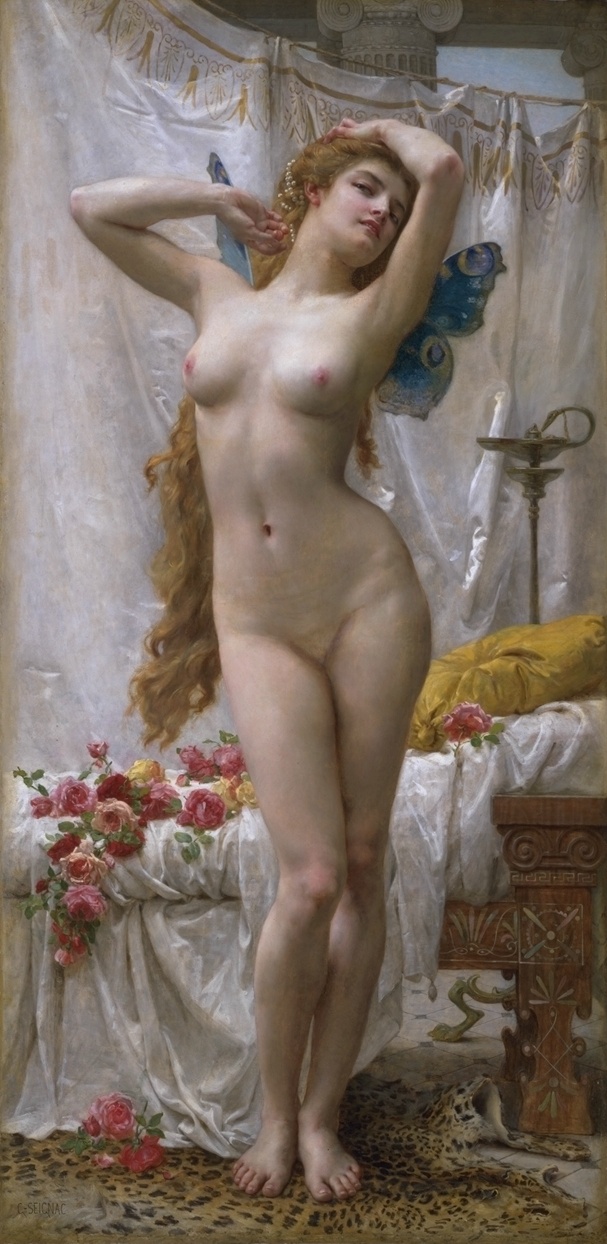
The Awakening of Psyche by Guillaume Seignac

The Awakening of Psyche (Le Réveil de Psyché), Salon de 1904, by French painter Guillaume Seignac (1870-1924).

Thursday, June 10, 2010

Psyche by Bertel Thorvaldsen

Photo: Psyche, sculpture by Danish/Icelandic sculptor Bertel Thorvaldsen (1770-1844) in Alte Nationalgalerie, Berlin, Germany