Showing posts with label nymphs. Show all posts

Saturday, November 20, 2010

Frederic Leighton: Actaea, the Nymph of the Shore

Public Domain image: Actaea, the Nymph of the Shore (1853 - 1858) - oil on canvas painting by the British painter Frederic Leighton (1830-1896), dimensions 57.2 cm x 102.2 cm, located at The National Gallery of Canada (Musée des beaux arts du Canada), Ottawa, Ontario, Canada.

Friday, October 15, 2010

Jean-Baptiste Camille Corot: Bacchante with a Panther

PD Image: Bacchante with a Panther, oil painting on canvas painting by French landscape painter Jean-Baptiste Camille Corot.

Jean-Baptiste Camille Corot, born in Paris on 16 July 1796, is an impressionist painter known for his beautiful landscape paintings. Corot is sometimes called the father of Impressionism. He died in Paris on 22 February 1875, was buried in Pere Lachaise.

Tuesday, September 21, 2010

Nicolas Poussin - Acis and Galatea (1629)

PD Image: Acis and Galatea (1629), painting by French classical painter Nicolas Poussin (1594-1665), located at the National Gallery of Ireland, Dublin.

Acis was the spirit of the Acis River in Sicily, beloved of the sea-nymph Galatea, who returned the love of Acis, but a jealous suitor, the Sicilian Cyclops Polyphemus, killed him with a boulder. Galatea then turned the blood of Acis into the River Acis. The Acis River flowed past Akion (Acium) near Mount Etna in Sicily.

Acis was the son of Faunus and the river-nymph Symaethis, daughter of the River Symaethus.

According to Athenaeus (200 BCE) the story was first concocted as a political satire against the Sicilian tyrant Dionysius I of Syracuse, whose favourite concubine, Galatea, shared her name with a nereid mentioned by Homer. Some others claim that the story of Galatea was invented to explain the presence of a shrine dedicated to Galatea on Mount Etna.

The tale of Acis and Galatea became very popular from the Renaissance period with many paintings on Acis and Galatea by artists such as Adam Elsheimer, Nicolas Poussin (National Gallery of Ireland) and Claude Lorrain (Dresden).

Nicolas Poussin (1594-1665) was a French painter in the classical style, acclaimed for his work predominantly featuring clarity, logic, and order, and his preference of line over color. Nicolas Poussin was a major inspiration for classical artists such as Jacques-Louis David, Jean-Auguste-Dominique Ingres and Paul Cézanne.

Wednesday, August 11, 2010

Hermaphroditus and Hermaphrodites

PD Photo: Hermaphroditus, marble sculpture at Lady Lever Art Gallery, Port Sunlight Village, Wirral, England, photo taken on 15 July 2006.

PD Image: The metamorphosis of the nymph Salmacis and Hermaphroditus (alternatively known as ‘Verwandlung von Hermaphroditos und Salmicis’ or ‘De gedaanteverwisseling van Hermaphroditus en de nimf Salmacis’) by Flemish painter Jan Gossaert (1478-1532) created in the year ± 1517, oil on panel, size 32.8 cm x 21.5 cm (12.91 in x 8.46 in), located at Museum Boijmans Van Beuningen, Rotterdam.

PD Image: The Nymph Salmacis and Hermaphroditus (1828) by Belgian neo-classical painter François-Joseph Navez (1787-1869).

The term ‘hermaphrodite’ is derived from the Greek mythological character Hermaphroditus, who fused with the nymph Salmacis, resulting in one individual possessing the physical traits of both male and female. Hermaphroditus was the son of Hermes and Aphrodite.

Salmacis is an atypical naiad (nymph) whose attempted rape of Hermaphroditus places her as the only nymph rapist in the Greek mythological canon. In Ovid's Metamorphoses, she becomes one with Hermaphroditus, and Hermaphroditus curses the fountain to have the same effect on others, or whoever comes to the fountain of Salmacis (located near the Mausoleum of Halicarnassus) will become effeminate.

Earlier, the word ‘hermaphrodite’ was used to describe a person incompatible with the biological gender binary, but it has recently been replaced by the word ‘intersex’ in medical science.

People with intersex conditions (hermaphrodites) may choose to live exclusively either as male or female, using clothing, social cues, genital surgery and hormone replacement therapy to blend into the sex they identify themselves with more closely. Some intersexual people outwardly appear completely female or male, without realizing that they are intersexual. Intersex is hypothesized to be caused by unusual sex hormones that may be caused by an atypical set of sex chromosomes.

Thursday, August 5, 2010

Nymph and Satyr (Bacchantin) by Annibale Carracci

Image: Nymph and satyr (Bacchantin) 1590 oil on canvas painting (detail) by Italian Baroque painter Annibale Carracci (1560-1609), dimensions 112 cm x 142 cm (44.09 in x 55.91 in), located at Galleria degli Uffizi, Florence, Italy.

According to Greek mythology, satyrs are male companions of Pan and Dionysus. Satyrs roamed the woods and mountains. They are associated with male sex drive, are lovers of wine, women and boys, and always ready for physical pleasures. They love to dance with nymphs and whom they often pursue them. They are subversive, roguish and dangerous, yet shy and cowardly and faint-hearted folk.

The Nereides by Gaston Bussiere

Image: The Nereides (1902), oil on canvas painting by French painter and illustrator Gaston Bussiere (1862-1929), located in private collection.

According to Greek mythology, Nereids are sea nymphs, the fifty daughters of Nereus and Doris, often accompanying Poseidon. They are always helpful for fishermen and sailors who face storms and other dangers in the sea. The most famous Nereids are Thetis, wife of Peleus and mother of Achilles; Amphitrite, wife of Poseidon; and Galatea, love of the Cyclops Polyphemus.

Wednesday, August 4, 2010

Diadumenè by Edward Poynter

Photo: Diadumenè, (1884) oil on canvas painting by English painter, designer, draughtsman and art administrator Sir Edward John Poynter, 1st Baronet, KB PRA (1836-1919), dimensions 20 x 20 inches, located at Royal Albert Memorial Museum, Exeter.

Tuesday, July 6, 2010

Diana and Her Nymphs Bathing by Jean-Francois de Troy

Image: Diana and Her Nymphs Bathing (1722-24), oil on canvas painting by French Rococo painter and tapestry designer Jean-François de Troy (1679-1752).

Saturday, June 26, 2010

Nymph and Cupid by William Edward Frost

Nymph and Cupid (1870) oil on canvas by English painter William Edward Frost (1810-1877)

Wednesday, June 16, 2010

Water Nymph, by Paul Raphael

Water Nymph (La Nymphe des eaux), sculpture by English-born sculptor Paul Raphael Montford (1868-1938), who worked in Australia.

The Beautiful Well, sculpture in Schonbrunn Garden

The Beautiful Well (Nymphe Egeria) is a sculpture in the Schönbrunn Garden of Schönbrunn Palace, a former imperial summer residence in Vienna, Austria. As it is one of the most important cultural monuments in Austria, it has become one of the major tourist attractions in Vienna. The palace and gardens illustrate the tastes, interests, and aspirations of successive Habsburg monarchs. The sculptures in the Schonbrunn Garden were mostly created between 1773 and 1780 under the direction of Johann Wilhelm Beyer, employing many sculptors.

Water Nymph: by Otto Theodore Gustav

Water Nymph (before 1917), oil on canvas painting by Otto Theodore Gustav Lingner (1856-1917), 70 cm x 92 cm (27.3” x 36.2”), private collection.

Cave of the Storm Nymphs by Edward Poynter

Cave of the Storm Nymphs (1903) by British painter Sir Edward John Poynter (1836-1919), oil on canvas painting, dimensions 145.9 cm x 110.4 cm, private collection.

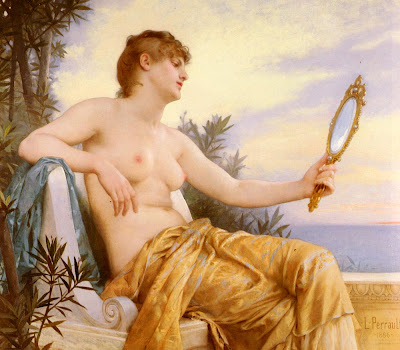
Oil paintings by Leon Bazille Perrault

Here below are a few oil-on-canvas paintings by French painter Léon Jean Bazille Perrault (1832-1908), who exhibited at the Salon from 1863 onwards.

A Water Nymph (1898)

Vénus à la colombe

The Bird Charmer

Vanitas

Meditation

Tuesday, June 15, 2010

The Wave by Guillaume Seignac

Image: The Wave (alternate names: ‘La Vague’ or ‘Fala’) oil painting by French painter Guillaume Seignac (1870-1924).

Nymph at the Fountain by Guillaume Seignac

Nymph at the Fountain (alternate names: ‘Nymphe à la pièce d'eau’, ‘Nimfa obok fontanny’), oil painting by French painter Guillaume Seignac (1870-1924).

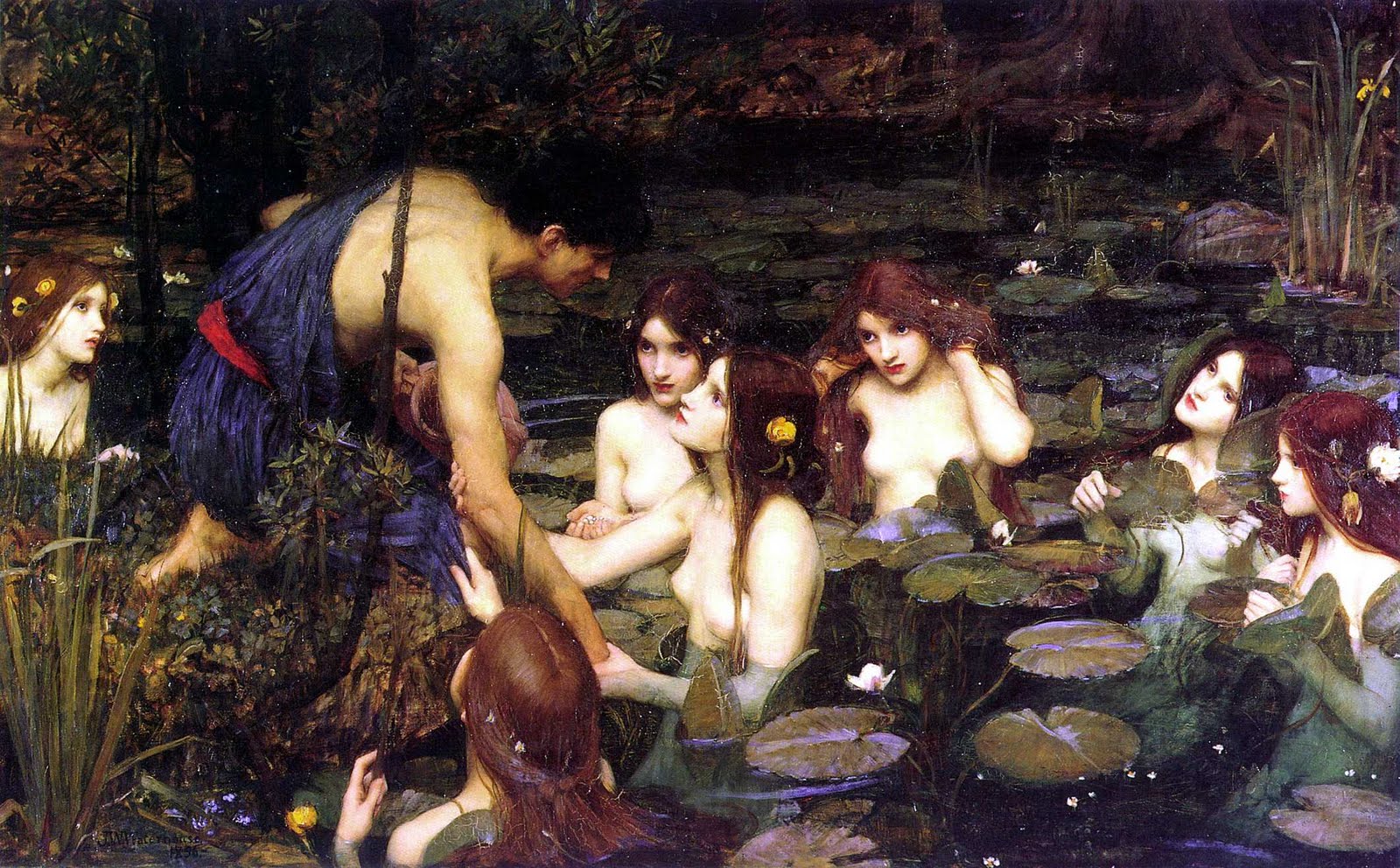
Hylas and the Nymphs by John William Waterhouse

‘Hylas and the Nymphs’ (alternate names: Hylás a Nymfy, Hylas und die Nymphen), 1896 oil on canvas painting by British painter John William Waterhouse (1849-1917), size 98 cm x 163 cm, located at City Art Galleries, Manchester, U.K.

Nymphes dansant by Adriaen van der Werff and Pieter van der Werff

Image: Nymphes dansant (Deux femmes dansant devant un berger jouant du pipeau, dit aussi Nymphes dansant), a 1718 oil-on-panel painting by Dutch painters Adriaen van der Werff and Pieter van der Werff, size 58.5 cm x 44 cm (23.03” x 17.32”), located at Musée du Louvre, Richelieu, 2nd floor, room A, Paris, France.

Pieter van der Werff was the principal pupil and assistant of Adriaen van der Werff. Nymphes dansant was a further development or improvement upon the theme of Adriaen’s painting ‘Een dansende nymf op het fluitspel van een herder’ (1718).

Een dansende nymf op het fluitspel van een herder by Adriaen van der Werff

Image: Een dansende nymf op het fluitspel van een herder (A nymph dancing before a shepherd playing a flute), a 1718 oil on panel painting by Dutch painter Adriaen van der Werff, dimensions 44 cm x 33 cm (17.32” x 12.99”), located at Rijksmuseum Amsterdam, Amsterdam, The Netherlands.

Sunday, June 13, 2010

Nymphe by Luis Ricardo Falero

Image: Nymphe, oil on canvas painting by Spanish painter Luis Ricardo Falero (1851-1896).