PD Image: A rabequista árabe (The Arabic fiddler), 1884 oil on canvas painting by Brazilian academic painter, writer and teacher Pedro Américo (1843-1903), dimensions 87.6 cm x 60 cm (34.49 x 23.62 inches), currently located at Museu Nacional de Belas Artes, Rio de Janeiro.
Sunday, September 19, 2010
Pedro Américo - A rabequista árabe
Saturday, September 11, 2010
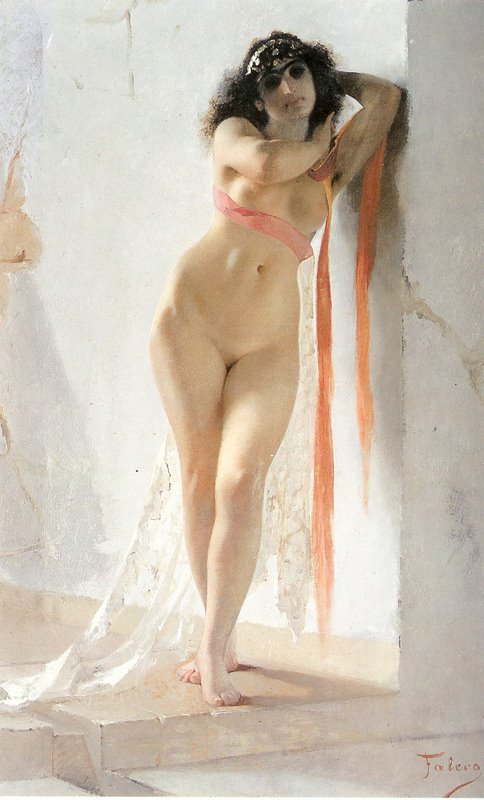
Luis Ricardo Falero: Oriental Woman
PD Image: Oil on canvas painting by Spanish painter Luis Ricardo Falero (1851-1896) representing a Nude Oriental Woman, scan from photo in the book ‘Historia del Arte’.
Thursday, July 29, 2010
Oil Paintings by Paul Désiré Trouillebert
Diana the Huntress (alternatively ‘Polująca Diana’ or ‘Diana Chasseresse’) by Paul Desiré Trouillebert
The Harem Servant Girl (Servante du harem, 1874) by French painter Paul Désiré Trouillebert (1869-1900)
The Nude Snake Charmer (La charmeuse de serpents), oil on canvas painting (possibly painted around 1880) by Paul Trouillebert
Paul Desiré Trouillebert (1869-1900), the famous French painter of Barbizon School is known for his portrait paintings and landscapes. He was interested in Orientalism and produced paintings of with oriental settings. For instance, he painted a portrait of a half-nude young servant woman (The Harem Servant Girl) in an ancient Egyptian style of the Greco-Roman Dynasty. The Hookah, the banana plant and the headgear of the girl are typical of oriental settings. Similarly, in the Nude Snake Charmer, the theme itself and the cobra represent oriental ideas.
Thursday, July 8, 2010
A Yemeni doctor examines an infant
Photo: A female physician in the Republic of Yemen examines an infant in a USAID-sponsored health care clinic, photo (2006) by Ben Barber (USAID). Over the past several fiscal years, Yemen has received on average between $20 and $25 million annually in total U.S. foreign aid.
Muslims were in fact the first to employ women in hospitals, as it was necessary due to the segregation between male and female patients in Islamic hospitals. A unique feature of medieval Muslim hospitals was the role of female staff, including female nurses. Muslim hospitals were also the first to employ female physicians, the most famous being two female physicians from the Banu Zuhr family who served the Almohad ruler Abu Yusuf Ya'qub al-Mansur in the 12th century AD. Later in the 15th century, female surgeons were illustrated for the first time in Şerafeddin Sabuncuoğlu's Cerrahiyyetu'l-Haniyye (Imperial Surgery).
Thursday, July 1, 2010
The Pharaoh's Handmaidens
Monday, June 14, 2010
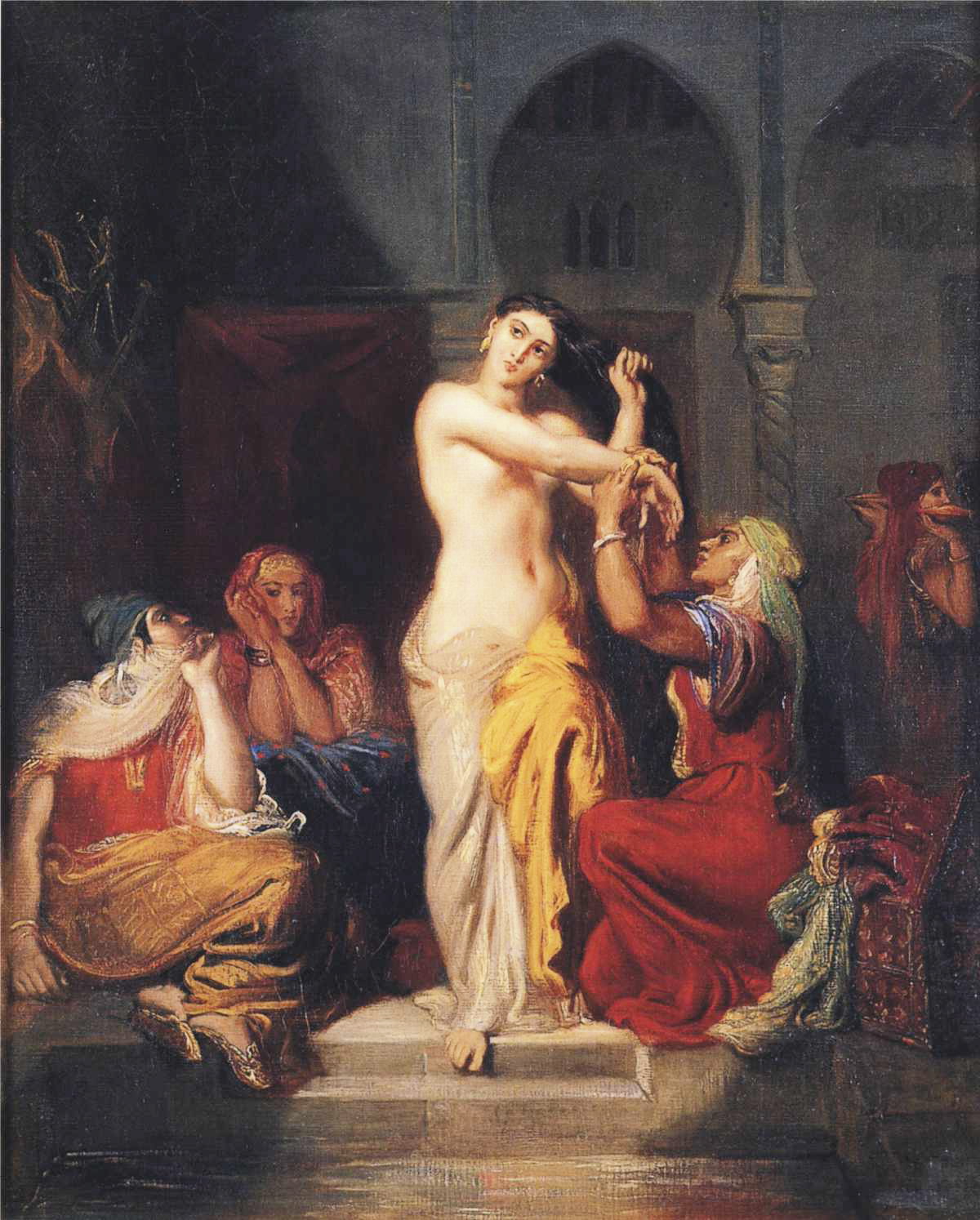
Moorish Woman Leaving the Bath in the Seraglio
Scan of painting: ‘Moorish Woman Leaving the Bath in the Seraglio’ (1854) painting by French painter Theodore Chasseriau, oil on canvas, 67 cm x 54 cm, located in Musée des Beaux-Arts, Strasbourg, Germany.
Harem, painting by Théodore Chassériau
Image: Harem, 19th century oil on canvas painting by French painter Théodore Chassériau (1819-1856) who was a noted for his portraits, historical and religious paintings, murals and Orientalist paintings.
The Toilette of Esther by Théodore Chassériau
Image: The Toilette of Esther or La toilette d'Esther, an 1841 oil-on-canvas painting by French romantic painter Théodore Chassériau (1819-1856), with dimensions 45.5 cm x 35.5 cm (17.9” x 14.0”), presently located in Musée du Louvre, Paris, France.
The Toilette of Esther depicts an incident from the Book of Esther, when Esther prepared herself to meet the ruler of Persia King Ahasuerus, who subsequently married her.
The theme of the painting is derived from the Book of Esther (2:8-9, 15), in which King Ahasuerus seeks a new queen after renouncing his wife Vashti. Esther, a woman of great beauty, finds favor with Hegai, the eunuch in charge of preparing women for presentation to the king. After seeing Esther, Ahasuerus chooses her as his wife. She later reveals that she is Jewish, and wanted the king to spare the lives of the Jews in his empire.
The choice of this Old Testament story about a young woman in a harem freed Chassériau to take advantage of elements of the Orientalist and Romantic movements. The presence of Asian women and ample jewelry further romanticizes Esther’s figure. Having previously painted a ‘Birth of Venus’ and a ‘Susanna and the Elders’, Chassériau found another theme in Esther which permitted a frankly sensual presentation of the female body.
It has been noted by art historians that the painting, ‘The Toilette of Esther’, later inspired painters such as François-Léon Benouville and Gustave Moreau. Vincent Pomarède of the Museum of Fine Arts of Lyon described the work as ‘one of the most famous (paintings) in the Louvre’.
Sunday, June 13, 2010
Enchantress by Luis Ricardo Falero
Image: Enchantress (Enchanteresse), oil on canvas painting by Spanish painter Luis Ricardo Falero (1851-1896), created in 1878.
An Oriental Beauty by Luis Ricardo Falero
Image: An Oriental Beauty, oil on canvas painting by Spanish painter Luis Ricardo Falero (1851-1896), dimensions 73.6 cm x 41 cm (28.98” x 16.14”) currently in private collection.
Oriental Woman by Luis Ricardo Falero
Image: Oil on canvas painting by Spanish painter Luis Ricardo Falero (1851-1896) representing an ‘Oriental Woman’ (dated before 1896).
Sunday, June 6, 2010
Snake Charmer by Jean-Leon Gerome
Image: Snake Charmer (1870), oil on canvas painting by French artist Jean-Leon Gerome, dimensions 84 cm x 122 cm, currently located in Clark Art Institute, Williamstown, Massachusetts
Slave Market by Jean-Leon Gerome
Image: Slave Market, 1866 painting by French artist Jean-Léon Gérôme, oil on canvas dimensions 84.8 cm x 63.5 cm, currently located at Sterling and Francine Clark Art Institute, Williamstown, Massachusetts